I often see late summer bring a mix of emotions. You may feel lit up by sunshine and connection, yet tired from overscheduling. Nervous systems that ran on excitement in July often ask for steadiness in September. Therapy can offer that shift. So can creative practice.
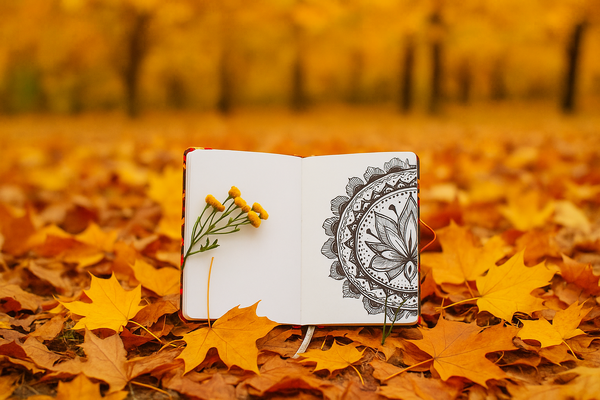
Mandalas give us a simple way to return to center. The circle contains what feels scattered and helps the body and mind reorient. This is not about creating art for display. It is about presence, breath, and regulation.
From outward to inward
Warm months invite us outward. We join plans, travel, talk late, and say yes. These experiences can be nourishing. They can also stretch us past our limits. If you notice both gratitude and fatigue, you are not alone.
Rather than push those feelings aside, try an intentional close to the season. Think of it as a gentle landing.
A short reflection to land the season
Take five minutes and a pen.
- Name three moments that truly fed you.
- Name two places where you felt depleted.
- Name one lesson your summer taught you about your limits.
- Name one thing you wish to set down as the light changes.
There is no correct list. There is only honesty and care.
Mandalas as a therapeutic tool
The word mandala comes from Sanskrit and refers to a circle. Many cultures have used circular imagery to hold meaning. You may have seen it in Tibetan sand art, Christian rose windows, or Indigenous medicine wheels. In modern psychotherapy, Carl Jung viewed mandalas as images of the self moving toward wholeness. In the therapy room today, I use mandalas to support regulation, insight, and integration.
When my own life carried deep grief after my mother’s passing, I drew small circles in a pocket notebook. Shapes and colors became a language when words were not ready. The drawings did not erase loss. They helped me hold it with steadiness.
A simple practice you can try today
You will need paper and something to draw with.
- Draw a circle. Use a cup or trace your hand to make the shape if that feels easier.
- Sit for three breaths. Feel your feet on the floor.
- Inside the circle, let your hand move. Lines. Dots. Petals. Scribbles. Allow what wants to appear.
- When you feel complete, add a word at the edge of the circle that names the quality you want to carry into autumn. Examples include ease, focus, or warmth.
- Place the page somewhere you will see it this week. Each time you notice it, take one calming breath.
This practice can settle your system, clarify what matters, and create a felt sense of closure.
If your body is asking for structure again
Some people arrive in September craving routine. Others need rest and quiet after being social for months. Both are valid. Consider one supportive boundary you can set for the next two weeks. Examples include a regular bedtime, a device-free meal, or an hour for creative play. Small and consistent often works best.
An invitation for the season shift
To support this transition, I am offering a small therapeutic Mandala Retreat for the close of summer and the start of fall.
We will use guided mandala making, gentle somatic practices, and focused prompts. You will be invited to release what no longer serves and to name what you want to nurture next.
A somatic pause you can take right now
Place one hand on your heart and one on your belly.
Let your eyes soften. Inhale slowly through your nose.
Hold for a quiet moment.
Exhale with a soft sigh.
Notice any shift in your shoulders, jaw, or chest.
Ask yourself. What is one quality I want to bring into the new season?
Ask again. What is one thing I am ready to release?
Trust the first answer.
With care,
Mari Grande, LCAT, ATR BC

Mari Grande is a Licensed Clinical Social Worker and a Creative Arts Psychotherapist in New York, New Jersey, California, and Florida with 20+ years of experience working with individuals and groups. She specializes in using creativity to help people heal from traumatic events.