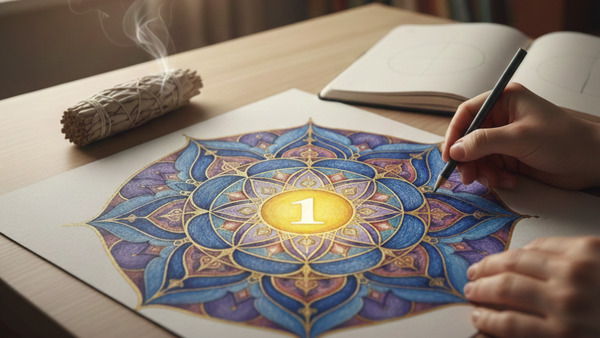
January and the Power of One
Start the year with the energy of one. Explore the MARI Mandala, a brief drawing practice, and reflective questions to support unity, healthy boundaries, and healing.
January and the Power of One Read More »

Start the year with the energy of one. Explore the MARI Mandala, a brief drawing practice, and reflective questions to support unity, healthy boundaries, and healing.
January and the Power of One Read More »

As the year bows its head, reflection arrives like a quiet visitor. The days move quickly, yet my inner clock begins to slow. I listen more closely. I choose what matters. This year opened with a bright drumbeat. A new team formed around my work. Paint returned to my hands. I felt spark and flow. Then life asked me to tend what was tender. My mother became very ill, and our path turned sorrowful. Grief rearranged my calendar and my cells. My work changed. My energy changed. I changed. I remain devoted to healing the Mother Wound. I am leaning even more into the medicine of art therapy, mandala making, and intuitive coaching. I am now a Certified Intuitive Coach, and that training has woven a golden thread through everything I offer in therapy and groups. If you would like to hear how this looks in session, I am happy to share. Why mandalas in therapy A small story. My very first painting as a pre-kindergartner was a mandala, though I did not have that language yet. I called it a Turtle. I can still feel the easel towering above me, the colors singing, my four-year-old self stepping back with a grin that felt larger than the room. Pure exhilaration. The circle kept finding me. In undergraduate art school, I drew a series called Avocados, each with a seed or an opening at the center. In graduate school, my drawings leaped off the page and became sculpted circular forms. The shape of the mandala has been walking beside me for a long time. The MARI Mandala Assessment in my practice As an art therapist I grew curious about the MARI method, the Mandala Assessment Research Instrument created by Joan Kellogg. MARI describes a cyclical journey through twelve, sometimes thirteen, stages often called the Great Round. The map is influenced by Carl Jung’s work influences the map and offers a compassionate way to witness where we are in our process. In therapy, MARI can illuminate strengths, name transitions, and support clarity for next steps. December, Stage Twelve, and the return to wholeness Here we are in the twelfth month. In MARI, the twelfth stage invites a return to wholeness through acceptance. We soften our grip. We gather what the year taught us. We allow completion to prepare the soil for beginnings already stirring. A gentle mandala practice for this month I would be honored to witness what you create. You can send a photo of your mandala through my contact page or share it on Instagram and tag @creativehealingintegration. Circle of practice I will be opening a monthly circle that journeys through the Great Round together. Each month, we will explore one stage, create a mandala, and translate its symbols into language that supports healing and next steps. This is a sweet spot where science, creativity, and intuition braid into something quietly powerful. If that resonates, add your name to the interest list, and I will keep you posted. May this month bring you a gentle settling. May acceptance open the door. May your circle lead you home. Work with me I provide art therapy and trauma therapy in New York City and online. My approach integrates the MARI Mandala Assessment, expressive arts, and intuitive coaching to support nervous system regulation, grief work, and Mother Wound healing. If you are ready for a soft return to yourself, you can schedule a consultation, and we will begin. With care,Mari Grande, LCAT, ATR BC
December Reflections. Mandalas and the Return to Wholeness Read More »
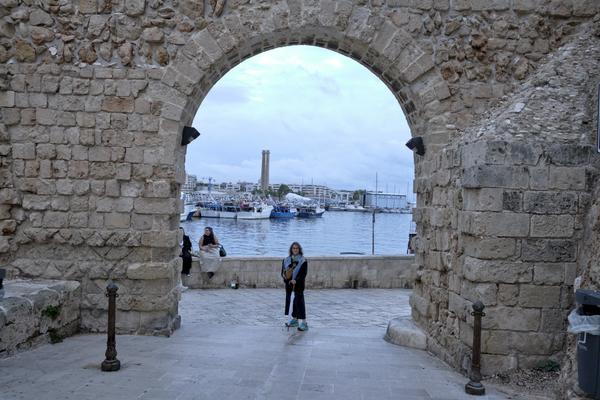
A long awaited trip to Italy turned into a lesson in trust, creativity, and the quiet work of returning to center. Join me in The Mandala Corner this November. I had been planning this trip for months. A direct flight to Italy. An itinerary filled with highlights from Puglia, Naples, and the Amalfi Coast. Even our kittens were set. We found a kind and competent live in sitter. Everything felt beautifully aligned. What could go wrong At first, everything went as expected. The usual travel bumps, small delays, moments of adjusting to a new rhythm. All part of the adventure. Until day four. A message came from our cat sitter. One of our kittens was in distress. She took him to the vet, who quickly referred him to the emergency room. They did not know if he had ingested a toxin or was having a neurological event. My heart dropped. This was not supposed to happen. Our kittens are only seven months old. They are healthy, playful, vaccinated, and full of life. Suddenly one of them was fighting for his. He was admitted to the intensive care unit. He was limp, blind, and unable to stand or eat. Even the specialists were not sure what was happening or if he would survive. My dream vacation became a stress vacation. Jet lag, worry, and sleepless nights waiting for updates. By day six, a small miracle. He turned a corner. The vets said he could go home to be monitored. The relief was enormous. I am happy to share that today he is thriving. In fact, he is playing fetch with me as I write this. As for me, the exhaustion settled in. The sore throat and cough were not just stress. I had COVID. But that is not really the story. The story is about what happened within all that uncertainty. How life gently pulled me out of my linear plans and back into the circle. The Circle That Holds Between vet calls and naps, I found myself sketching mandalas. I began noticing circles everywhere. Church domes, tiled floors, and the petals of ancient mosaics. Circles within circles. No beginning. No end. Only balance, symmetry, and quiet containment. Each one seemed to whisper, You are held. The circle reminds me of the womb. It is that original place of safety and creation. It is also the place we spend much of our lives trying to understand or return to. When things fall apart, the circle invites us back. It does not demand control or answers. It simply holds what hurts until it is ready to heal. In the MARI system, the Mandala Assessment Research Instrument, rosettes and flowers appear in Stages 8 and 9. These are the stages of personal ripening and authentic connection. Stage 8 speaks to autonomy, will, and creativity. Stage 9 expands that energy outward into connection, contribution, and love. Italy showed me both. The joy of blossoming and the necessity of softening. Of letting go of what I thought I was there to do and listening instead for what the moment asked of me. When Plans Change Do your plans always unfold the way you hope Mine did not. It is okay to feel disappointed when life takes a turn. When you only have eight days to explore a dream destination, there is not much space for wallowing. I also worried that I might have unknowingly passed the illness to others. That too became part of the lesson. Not blame, but awareness. A pause. A breath. An invitation to sit with the unknown. Sometimes we are called to trust life. Not to like or fully understand what is happening, but to allow it to move us gently back toward center. Returning to Wholeness Everywhere I looked, Italy offered reminders of the circle’s wisdom. Rose windows in cathedrals. Halos in sacred paintings. The Eucharist. Even the crown of thorns. Each one spoke of wholeness. Wholeness is not perfection. It is presence. Even in disruption, life keeps inviting us back to that original shape. The circle that heals, holds, and reconnects. I will be exploring more of this in The Mandala Corner this November. If you feel called to return to your center, I invite you to join me. With care,Mari Grande, LCAT, ATR BC
What Italy Taught Me About Trusting the Unplanned Read More »

A Mother Wound is a cluster of symptoms that include: Being unsure of your choices. Finding fault in what you do, say, or think. Being critical of others, especially the ones closest to you. Not knowing how to communicate directly or effectively. The first step in understanding the Mother Wound is determining whether you have one. After that, you can delve deeper into the various types of Wounds, how they form, and why they form, among other aspects. That’s why it is best to begin with a Mother Wound quiz to get your bearing. When you take a test or quiz on a topic you want to explore, especially about yourself, it can serve as a guide, a tutor, or an invitation to discover which direction to take. The Mother Wound Quiz I created will capture the essence of how you’ve been affected by your nurturing experience. Is this the definitive Mother Wound test? NO What this quiz does reveal is whether your outlook and approach to life have been hampered by what a Mother Wound can imperil. Does this test gather enough information to be accurate? YES Even though we are complex and individual beings, there are very clear reveals that point out whether you are carrying a wound. You may be fully aware of your Mother Wound, curious about it, scared of it, or already on a journey to embrace and learn from your Mother Wound. What if I Have A Mother Wound? To be honest, we all carry a Mother Wound. The crucial question is whether it has been left to fester. Has it been confronted? Has it been overlooked? It is essential to understand what your Mother Wound is, how it was formed, when it developed, and if any healing has taken place. When we know a Mother Wound is affecting us, there are 2 real options: Why Understanding the Mother Wound Matters If you neglect your inner world, shaped by those who cared for you in your youth, and do not listen to your inner voice, you risk losing one of your greatest and most powerful senses—your awareness, guidance, and ability to find peace within yourself. If you sense something is lacking, if your relationships feel unstable, and if you feel as though you are struggling alone through wet, spongy, and muddy ground, understanding your Mother Wound is the beginning of something new, a beacon of light on solid ground. When you explore your attachment patterns, this sparks a journey of transformation and personal growth, particularly when you integrate your relationship with your body into the process. How the Mother Wound Can Show Up in Your Life Signs You’re Ready to Begin Healing You feel restless and decisive as if you’ve had enough. Do not ignore this energy or your body; it is communicating with you, asking that you listen to it. You want to feel better. All your hard work seems like it’s for not, but it’s been accumulating and building, and the results of your hard work are waiting for you. You are now ready to listen and receive what you only know intellectually. You want to open your heart. Your heart has been hurt, closed, and shut down, and for good reason. It’s time to trust there is more and know you cannot do it alone. This is how your heart can open. Listen and trust. Your heart is resilient and pure, always there, forever present, wanting your attention and never abandoning you. You want to heal in community. Your heart truly opens in relation to others and in community with others. You shut down from the pain or inflicted by another, and being with others is how it can open again. Of course, at first, this may be scary, and unfamiliar but deep down, you know that is where healing hurt really happens. You are resolved to do what it takes to connect with your own power. Imagine having that belief; now, feel the desire to connect to your own power in your body. Breathe into it. Notice your posture. Feel the promise, the resolve. Be with that and see where it wants to take you. What Happens When You Take the Mother Wound Test? Once you take the test, you will be given an assessment of how you’ve been affected by a Mother Wound. You will have a clearer sense of where you are in the spectrum of Mother Wounds. This will be followed up by some options for support, depending on your results. Take the Mother Wound Test If you’re ready to have a deeper understanding of how the Mother Wound could be affecting you in your life, relationships, and work, I invite you to take this quiz. When you take a test or quiz on a topic you want to explore, especially about yourself, it can serve as a guide, a tutor, or an invitation to discover which direction to take. The Mother Wound Quiz features a series of seemingly unrelated questions that evaluate whether a nurturing figure in your life has emotionally wounded you. If you have less than 5 minutes to answer 10 simple questions about yourself, much can be revealed. Take the Mother Wound Quiz here. What’s Next? If you are ready to move beyond the Quiz, I invite you to start by taking my eCourse for Daughters of Critical Mothers. My recently published Guidebook on Overcoming the Mother Wound is a supportive resource that includes resources, art and writing prompts, and more.
The Mother Wound Test Read More »

Have you ever eaten food that made your stomach sour? There is a good chance there was something toxic to you in that food. Your body knew what to do. Expel it ASAP. What if that “toxin” comes in the form of abuse, negativity, and criticism? From a mother who sees the world through her needs instead of her dependent child’s. A toxic mother-daughter relationship is when a daughter becomes an extension of her mother’s needs, rather than an extension that needs care and support to grow as a separate person, and be able to know her own voice. When a daughter is told to shut up, or that she is stupid, she is being fed negative toxins in her psyche. She is also building neural networks in the brain that begin to believe this about herself at a less conscious level. Especially when these toxins enter early in a child’s life, and are repeated over and over. It has been found that Neurons that wire together fire together.* Meaning, when we learn something new, we create new neural networks in our brain, and if that learning is coupled with an experience, that learning is paired. Left untreated, these neural pathways continue to feed the same information to our psyche. Deepening the negative internal experience and making it feel like reality. It is through having new experiences, that we can create new, life-enhancing neural pathways where neuroplasticity can take effect and real change can develop. Examples of a Toxic Mother-Daughter Relationship Toxic environments are found in more places than Chornobyl. From age 5, Rhonda’s mother would yell and slap her because she wanted to play with her friends instead of help around the house. As she got older, she watched as her mother scammed her tenants out of their deposits, cursing and blaming them for wanting their money back. Rhonda did not have any other adult role models to look up to, only her mother and her drunk father. She only knew that she did not like her life; it did not “taste” good, and she was in fear of her mother. She learned that to be loved is to be scared, and that adults are untrustworthy. Anne’s family immigrated from another country. Even after decades of living in the US, her mother never learned English. Anne helped run the household, do chores, pay bills, and read the mail as early as she could remember. She was her father’s favorite, but he was seldom around, and his English skills were limited. When he was around, she felt special. In the evening, when her father gathered men for gambling and drinking in the attic, one of these men took 4-year-old Anne into her room; no one noticed. The following day, when Anne told her mother that it “hurt down there,” she was told to stop lying and wanting extra attention. Twenty-five years later, she came to my office, feeling overworked and stuck in abusive relationships. We started to unpack the traumas of her childhood and begin the healing process. Anne experienced a horrible trauma, sought sustenance and support, only to be fed blame, criticism, and false accusations at a most vulnerable moment. At this moment, Anne’s mother-daughter relationship became toxic. Not only did her mother turn a blind eye to her 4-year-old daughter’s needs, but she also sided with her molester, who continued the abuse for years. Anne learned to hide her needs, including for nurturing and support. When there are no words, or the pain is buried, Art is a beautiful way of tapping into the intangible effects of toxic relationships and trauma. For instance, Manuel Neri (1930-2021), visually captured the effects of trauma in his sculpture. A California artist, he created sculptures of the human form in white plaster, much like the innocence we enter the world with. Then, he randomly spattered paint over their bodies, externalizing their inner emotional experience after a life of relationships and experiences that change us no matter how perfect we may start. Think of Rhonda, Anne, or even yourself as the pristine white plaster, and then see the splattered paint of inner emotional experiences from trauma or a toxic mother-daughter relationship. How to Heal from a Toxic Relationship With Your Mother When a child is exposed to the toxicity levels of Rhonda or Anne, or even less, certain steps can be taken to begin the healing process. Take an inventory: Areas to consider: Relationships – What is the quality of your friends, lovers, partner? This is where our wounds will be acted out or healed, but we need to know if we are healing or hurting. Spirituality – What is your relationship to your wise self, higher self, best self? If you yearn to have more dimensionality or practices, listen to that calling. Mental Stimulation – How are you feeding your mind? Where our thoughts go, energy flows, let your mind be fed as much nutrition as your body. Physical Stimulation – Is your body getting the movement it needs? Each person’s needs are different, but knowing what yours are is as important as getting the activity your body needs. Well-being – Do you feel good about your daily choices? Diet, rest, habits. We now know how much everything is connected, mind, body, and spirits. Work-life – Is there balance, satisfaction, or dissatisfaction? There will be short phases of over or under-working within reason. The true tell is whether you feel it is a choice, your choice, or if you have ongoing resentment and fatigue. This is a list to spend time with, journal about, and meditate on. You may be surprised by some of your answers. It is also a great exercise to do with a group of others. Mother wounds were not created in isolation, nor can they be healed in isolation. We need each other, we need the best of ourselves and the best of each other to give support, feedback, and the energy of a loving community. Structured
Toxic Mother-Daughter Relationships Read More »
Did you know that 32% of adults in the US struggle to form healthy relationships? and at least 25% of children face abuse or neglect. When we are treated poorly, we learn to treat ourselves and others poorly, which manifests into a Mother Wound. In this article, I’m going to help you understand if you have a Mother Wound, how it occurs, who experiences it, what it looks like, and how to overcome it. This post contains affiliate links including Amazon affiliate links. What is a Mother Wound? A Mother Wound is an emotional scar that forms when the mother-child bond is disrupted or the nurturing and consistency necessary for healthy development are lacking. As both a daughter and a therapist, I have personally experienced and witnessed the profound, long-lasting effects of this relationship. While mothers are the reason we are here—a fact I am deeply grateful for—most do not intentionally harm their children. Instead, it happens through a lack of resources, support, and unconscious patterns passed down through generations. When a primary relationship is fractured at a young age, it can feel like a bomb has gone off inside. The aftermath is like shrapnel floating inside, cutting and tearing at the soul. In place of consistency and care, the child may experience confusion and fear. For instance, a child who craves safety but encounters unpredictability might feel a profound sense of insecurity. Without understanding or naming these feelings, children adapt to survive. This adaptation may take the form of dissociation or creating alternate realities, such as imaginary friends or blank spots in memory. While helpful at the time, these coping mechanisms can create challenges later in life. Being a youngster is a time of magical thinking. For example, if I blink three times, it will make me prettier. When reality becomes too painful, this magical thinking can persist beyond the typical developmental stage of 2 to 7 years old. If it continues unchecked, it may evolve into maladaptive patterns, such as obsessive-compulsive tendencies, where recurring thoughts and repetitive behaviors serve as an attempt to regain a sense of control. Examples of the Mother Wound It can take many forms: These experiences can create feelings of confusion and self-doubt. It can even be experienced as “gaslighting,” where someone creates a false reality that undermines your experiences or facts. This psychological manipulation confuses a child and can even lead to psychosis in the extreme, A Mother Wound is Not to be Taken Lightly Many clients in my practice have dedicated years to working through this wound. It is not a quick fix; it touches the very essence of who you are. When a mother tells you how beautiful you are with your dark hair and strong features, like hers, when you watch a movie together and continually praises the fair, blonde, blue-eyed character, you wonder what she meant. Then, she praises other people and things so different from who you are that you begin to doubt your mother and the truth. Or a mother who attaches to a younger sibling while never connecting meaningfully with you. Or the blatant cruelty of a mother telling her daughter all the things wrong with her as she pulls her hair to “fix” her. These are some of the stories I know of; there are many more. Where Did The Mother Wound Term Come From? The term “Mother Wound” has become widely recognized in various communities. Authors such as Kelly McDaniel in Mother Hunger, Peg Streep in Daughter Detox, and Karyl McBride in Will I Ever Be Enough have explored it. In my private practice, I created a workbook that complements my courses and serves as a guide to overcoming the Mother Wound. However, Bethany Webster is often credited with pioneering this concept in her book The Inner Mother. Webster defines the Mother Wound as the conditioning experienced by most girls to disconnect from their truth. This split fosters anxiety, doubt, and shame, undermining a woman’s sense of self and empowerment. She emphasizes that cultivating an “Inner Mother” is essential for healing this early disconnection and providing the support we longed for as children. [source link] Collectively, these authors highlight the profound impact of the mother-child relationship, particularly on daughters. What Causes the Mother Wound? Behind the behavior of a mother who wounds, you often find a wounded mother herself—one grappling with insecurity, pain, and a lack of emotional tools. These often manifest in traits such as narcissism, self-absorption, a pervasive sense of inadequacy, or toxic behaviors like negativity, criticism, and an inability to show empathy. The Mother Wound is frequently part of an intergenerational cycle. A lack of emotional support, empathy, healthy boundaries, or consistency creates a deep psychic rupture that continues to be passed down until someone consciously chooses to break the cycle. Left unaddressed, this wound is handed down silently, often hidden in plain sight. It is commonly rooted in unprocessed grief, tragic events, loss, mental illness, or a lack of resources and education. Who are These Mothers that Wound? Beneath the surface, you will find narcissistic, toxic mothers who are self-involved, insecure, and in pain. This mother lacks empathy and favors distrust, disgust, and anger. The Mother Wound is part of an intergenerational pattern. When something is withheld, denied, shamed, neglected, punished without cause, never attended to, or never repaired, it causes a deep rupture in the psyche. The Mother Wounder does not provide emotional support, healthy boundaries, a sense of safety, or consistency. Exactly what children need to feel authentically loved in a relationship, trust others, and be themselves. If the wound is left to fester, it will be passed down until that daughter decides no more, gets support, and makes the change. Signs of a Mother Wound in Adulthood The Mother Wound in Relationships Our first relationship is with our mother, and this creates an imprint we carry with us into future relationships. If there is a wound left unexamined, this wound is repeated again and again, asking

My favorite part of summer is the lighter clothing, letting my feet breathe in sandals, summer mocktails (and an occasional cocktail), my annual painting retreat, and outdoor swimming.
Unveiling the Hidden Struggles of Summer: A Deep Dive into the ‘Mother Wound.’ Read More »

The summer months bring a unique blend of joy and challenges. While it is a time for relaxation and fun, it can also trigger feelings of overwhelm, especially if you are healing from a Mother Wound

Mothers and daughters are often seen as a package deal, however, the Mother-Son relationship has complex dynamics that impact a man into adulthood. If you have been following my blogs, then you are aware that I work closely with women who were raised by critical mothers. Of course, sons are not exempt from the struggle daughters have
Sons of Toxic Mothers Read More »

Are Mother Wounds exclusive? Picky? Gender-specific?
I don’t think so, actually, I know so. Mother Wounds are not only “sex blind” but they will be different for each and every one of us – whether we are male, female, trans, or nonbinary/gender-nonconforming.
It’s Not Just Daughters… Read More »