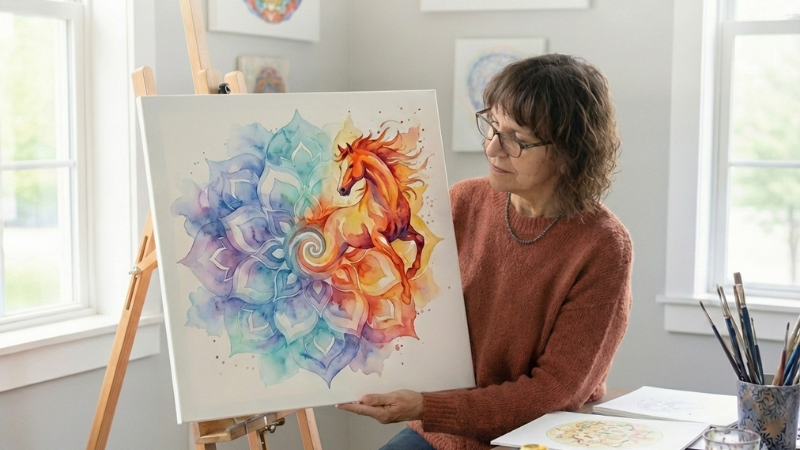

March as a Threshold, Exploring Stage Three of the M.A.R.I.
As we move into March, the third month of the year, we also arrive at Stage Three of the Mandala Assessment Research Instrument, often called the M.A.R.I. This alignment is not accidental. March carries the energy of awakening, and Stage Three marks the first emergence of conscious movement within the psyche. Together, they offer a powerful framework for therapeutic exploration and healing. In my therapeutic work, I often bridge the M.A.R.I. with early attachment experiences, including what is commonly known as the Mother Wound. The M.A.R.I. provides a symbolic and visual language that allows us to explore how we first learned to relate to ourselves, to others, and to the world around us. These early relational patterns are frequently formed before words are available, which is why mandala work can be so deeply effective. Developed by art therapist Joan Kellogg in the 1970s, the M.A.R.I. uses mandalas as both an assessment and a healing modality. Mandalas reach beyond intellectual understanding and access the deeper, less conscious layers of the psyche. This makes them especially useful in therapeutic settings where early emotional wounds may not yet have clear narratives. At its foundation, a mandala is a circle. The circle symbolizes wholeness, safety, and containment. It also reflects our earliest environment, the womb. This symbolism is essential when exploring early attachment and developmental experiences, as our sense of safety and connection begins long before conscious memory forms. The M.A.R.I. consists of twelve developmental stages, beginning with Stage One and completing at Stage Twelve, with the possibility of returning again to Stage Zero. These stages reflect both psychological development and spiritual growth. Rather than a linear achievement, they offer a living map of becoming that we move through repeatedly across the lifespan. One of the most meaningful therapeutic questions we can ask is this. How did you learn to attend to yourself? The answer is often shaped by what was modeled, what was permitted, and how emotional needs were responded to early in life. This is where attachment wounds often reside, not as a place of blame, but as a place of compassionate understanding. March corresponds with Stage Three, which represents the beginning of consciousness. Energy begins to stir. There is movement, curiosity, and a desire to engage with life. This stage often feels like waking at dawn after a long night. Alongside excitement, there may also be anxiety. Something new is beginning, and trust becomes an important part of the process. Stage Three is characterized by movement and emerging vitality. There is an inner sense that something wants to develop or evolve. In therapy, this stage invites awareness of where energy is flowing and what is ready to take form, even if it is not yet fully defined. When viewed through the lens of early attachment wounds, Stage Three can carry restlessness, longing, and quiet hope. There is an awakening sense that change is possible. While this awareness may still be preverbal, it holds momentum and direction. Within the Great Round of the M.A.R.I., Stage Three represents the movement toward conscious awareness. Energy is gathering, preparing to break through old patterns. It is the transition from containment toward exploration and growth. From a numerological perspective, the number three symbolizes expansion, creativity, and communication. This aligns naturally with Stage Three of the mandala, reinforcing themes of expression and emerging selfhood that are often explored during this phase of therapy. Mandala imagery associated with Stage Three frequently includes lines and forms that suggest motion and experimentation. These images reflect a psyche that is stretching beyond stillness and learning how to move with intention. Curiosity, playfulness, and even impatience are all natural expressions of this stage. March mirrors this energy in the natural world. Sap begins to rise. Buds form. Winds shift. Life is no longer dormant. It seeks expression. This makes March an ideal time to observe how energy is moving within your own emotional and relational life. Where do you notice momentum? What feels ready to begin? From a therapeutic and spiritual perspective, Stage Three is closely connected to vitality and will. Growth begins not with analysis, but with sensation, impulse, and intuitive awareness. Mandalas give shape to these early experiences, offering a visual language for what has not yet been spoken. When clients engage in mandala work connected to Stage Three, they often encounter unexpected emotions such as joy, frustration, hope, or restlessness. These experiences are not problems to solve. They are signals that energy is learning how to move and express itself. This is why mandala work can be so supportive in healing early attachment wounds. It allows what was once unseen or unsupported to be witnessed and held safely. Stage Three also teaches the importance of balance. Energy without direction can scatter, while too much structure too soon can inhibit growth. This stage invites gentle curiosity rather than pressure, and movement without force. Nature demonstrates this beautifully throughout March. As you move through this month, you may wish to reflect on these questions. Where do I feel energy beginning to awaken in my life?How can I express my vitality in ways that support healing and integration?What is beginning to emerge, even if it is not fully clear yet? Stage Three reminds us that healing and growth unfold gradually. We do not need to see the entire path in order to take the next step. Like March itself, it is enough to feel the pull toward light and respond with openness. This is part of the quiet wisdom of the M.A.R.I. Healing is not solely an intellectual process. It is a lived experience, guided by rhythm, symbol, and the deep intelligence within us all.
March as a Threshold, Exploring Stage Three of the M.A.R.I. Read More »